Monday, March 31, 2014

ፍኖት – የአዲስ አበባ ከተማ አስተዳደር የሰላማዊ ሰልፍና ስብሰባ ማሳወቂያ ክፍል ህገ ወጥ ደብዳቤ ለአንድነት ጻፈ

ምላሹን አልቀበልም በማለቱም በፖስታ ቤት ተልኮለታል ህገ መንግስቱ እውቅና የቸረው ሰላማዊ ሰልፍ የማድረግ መብት ሳይሸራረፍ መተግበሩን እንዲከታተል በአዋጅ የተቋቋመው የአዲስ አበባ ከተማ አስተዳደር የሰላማዊ ሰልፍና ስብሰባ ማሳወቂያ ክፍል አንድነት ለዴሞክራሲና ለፍትህ ፓርቲ መጋቢት 28/2006 ዓ.ም መነሻውን ፓርቲው ከሚገኝበት ቀበና በማድረግ በአራት ኪሎ አደባባይ በመዞር ጠቅላይ ሚኒስትሩ ጽ/ቤት ፊት ለፊት የሚጠናቀቅ ሰላማዊ ሰልፍ እንደሚያደርግ በመግለጽ ለኦፊሰሩ ደብዳቤ አስገብቶ የነበረ ቢሆንም መስተዳድሩ በአዋጅ የተሰጠውን ጊዜ ገደብ አሳልፎ ምላሽ ሰጥቷል፡፡ኦፊሰሩ በደብዳቤያቸው ‹‹በርካታ ትምህርት ቤቶች ዩኒቨርስቲና ፣የመንግስት ተቋማት በሚገኙበት አካባቢ ሰላማዊ ሰልፍ ለማካሄድ የማይቻል በመሆኑ የተጠየቀውን የሰላማዊ ሰልፍ እውቅና ጥያቄ ተቀባይነት ያላገኘ መሆኑን እንገልጻለን፡፡››ብሏል፡፡ የአገሪቱ ፓርላማ ‹‹ስለ ሰላማዊ ሰልፍና ሕዝባዊ የፖለቲካ ስብሰባ ስነ ስርዓት ባወጣው አዋጅ ‹‹የከተማው ወይም የአውራጃው አስተዳደር ጽ/ቤት ሰላማዊ ሰልፉ ወይም ሕዝባዊ የፖለቲካ ስብሰባው ምን ግዜም በየትኛውም ቦታ ሊካሄድ አይችልም ማለት አይችልም››(አዋጅ ቁጥር 3/1983 )በማለት ያወጀውን በአዋጁ ስር የተቋቋመው ጽ/ቤት በማን አለብኝነት በመሻር የሰላማዊ ሰልፍ ጥያቄውን አልተቀበኩትም ብሏል፡፡ አንድነት አዋጁን የጣሰውን ደብዳቤ እንደማይቀበል በመግለጽ ለኦፊሰሩ ደብዳቤ በመጻፍ በአካል ቢሯቸው በመገኘት ለመስጠት ቢሞክርም በአስገራሚ ሁኔታ ኦፊሰሩ ደብዳቤውን አልቀበልም ብለዋል፡፡
የኦፊሰሩ ድርጊት ህገ ወጥ መሆኑን የተገነዘበው ፓርቲያችን ደብዳቤውን ቢሯቸው ጠረጴዛ ላይ ትቶ ከመውጣቱም በላይ በሪኮማንዴ እንዲደርሳቸው አድርጓል፡፡ ኦፊሰሩ እየሰሩ የሚገኙት ነገር ህገ ወጥ መሆኑን እንዲገነዘቡም ለፌደራል ፖሊስ፣ለአዲስ አበባ ከተማ ፖሊስ በግልባጭ ደብዳቤው እንዲደርሳቸው መደረጉን የአንድነት የአዲስ አበባ ዋና ጸሐፊ አቶ ነብዩ ባዘዘው ተናግረዋል፡፡ በህገ ወጥ ደብዳቤ የሚሰረዝ ሰላማዊ የህዝብ ጥያቄ ባለመኖሩም ሰላማዊ ሰልፉ በተያዘለት ቀነ ገደብ እንደሚደረግ አቶ ነብዩ ጨምረው ገልጸዋል፡፡

Wednesday, February 12, 2014

Hacking Team and the Targeting of Ethiopian Journalists

Authors: Bill Marczak, Claudio Guarnieri, Morgan Marquis-Boire, and John Scott-Railton.
This post is the first in a series of posts that focus on the global proliferation and use of Hacking Team’s RCS spyware, sold exclusively to governments.

Summary

  • Ethiopian Satellite Television Service1 (ESAT) is an independent satellite television, radio, and online news media outlet run by members of the Ethiopian diaspora.  The service has operations in Alexandria, Virginia, as well as several other countries.2  ESAT’s broadcasts are frequently critical of the Ethiopian Government.  Available in Ethiopia and around the world, ESAT has been subjected to jamming from within Ethiopia several times in the past few years.3  A recent documentary shown on Ethiopian state media warned opposition parties against participating in ESAT programming.4
  • In the space of two hours on 20 December 2013, an attacker made three separate attempts to target two ESAT employees with sophisticated computer spyware, designed to steal files and passwords, and intercept Skype calls and instant messages.  The spyware communicated with an IP address belonging to Ariave Satcom, a satellite provider that services Africa, Europe, and Asia.5  In each case, the spyware appeared to be Remote Control System (RCS), sold exclusively to governments by Milan-based Hacking Team.6
  • Hacking Team states that they do not sell RCS to “repressive regimes”,7 and that RCS is not sold through “independent agents”.8  Hacking Team also says that all sales are reviewed by a board that includes outside engineers and lawyers.  The board has veto power over any sale.9  Before authorizing a sale, the company states that it considers “credible government or non-government reports reflecting that a potential customer could use surveillance technologies to facilitate human rights abuses,” as well as “due process requirements” for surveillance.10
  • The Committee to Protect Journalists (CPJ) reports that Ethiopia jails more journalists than any other African country besides Eritrea, and says that the Ethiopian government has shut down more than 75 media outlets since 1993.11  CPJ statistics also show that 79 journalists have been forced to flee Ethiopia due to threats and intimidation over the past decade, more than any other country in the world.12  A 2013 Human Rights Watch (HRW) report detailed ongoing torture at Ethiopia’s Maekelawi detention center, the first stop for arrested journalists and protests organizers.  Former detainees described how they were: “repeatedly slapped, kicked, punched, and beaten,” and hung from the ceiling by their wrists.  Information extracted in confession has been used to obtain conviction at trial, and to compel former detainees to work with the government.13  HRW also indicated abuses committed by the army, including the use of torture and rape to compel information from villagers near the site of an attack on a farm.14  HRW noted “insufficient respect for … due process” in Ethiopia.15

Background

Hacking Team and Remote Control System (RCS)

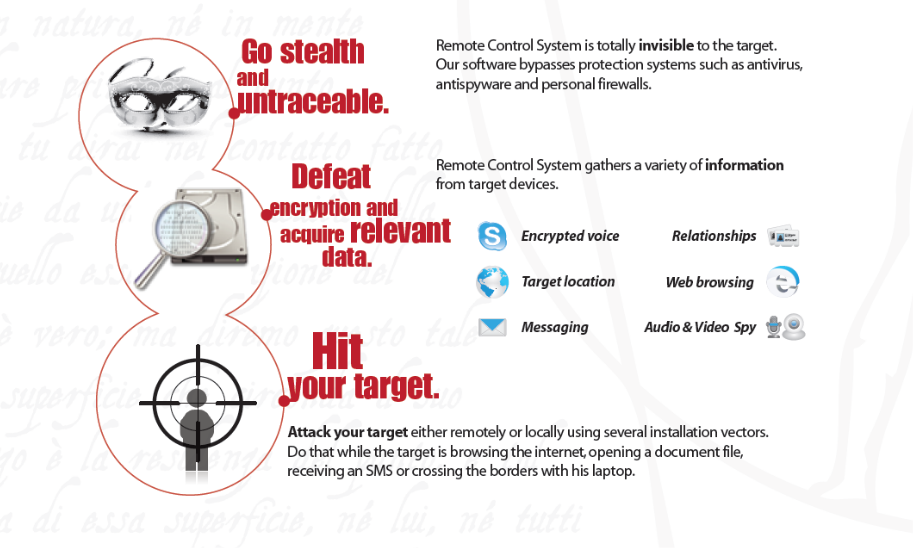
Hacking Team, also known as HT S.r.l., is a Milan-based purveyor of “offensive technology” to governments around the world.  One of their products, known as Remote Control System (RCS), is a trojan that is sold exclusively to intelligence and law enforcement agencies worldwide.  Hacking Team’s website describes the product as “the solution” to monitor targets that are increasingly using encryption, or those located outside the borders of the government that wants to monitor them.16
image00Description of RCS in a 2011 official brochure.17
RCS infects a target’s computer or mobile phone to intercept data before it is encrypted for transmission, and can also intercept data that is never transmitted.  For example, it can copy files from a computer’s hard disk, and can also record Skype calls, e-mails, instant messages, and passwords typed into a web browser.18  Furthermore, RCS can turn on a device’s webcam and microphone to spy on the user.19
While Hacking Team claims to potential clients that RCS can be used for mass surveillance of “hundreds of thousands of targets”,20 public statements by Hacking Team emphasize RCS’s potential use as a targeted tool for fighting crime and terrorism.21
Hacking Team was first thrust into the public spotlight in 2012 when RCS was used against award-winning Moroccan media outlet Mamfakinch,22 and United Arab Emirates (UAE) human rights activist Ahmed Mansoor, who was pardoned23 after serving seven months in prison for signing an online pro-democracy petition.24  Mansoor was infected, his GMail password was stolen, and his e-mails were downloaded.25  At the same time, RCS is apparently being used by foreign governments to target individuals on US soil.26,27
Evidence of the use of RCS against journalists and activists led Reporters Without Borders to name Hacking Team as one of the five “Corporate Enemies of the Internet”.28 Hacking Team Senior Counsel Eric Rabe responded with a defense of his company’s sales practices, in which he stated that Hacking Team does not provide its products to “repressive” regimes.29
On the issue of repressive regimes, Hacking Team goes to great lengths to assure that our software is not sold to governments that are blacklisted by the E.U., the U.S.A., NATO and similar international organizations or any “repressive” regime.
“Repressive” is a subjective term that may be difficult to define.  We instead look to a selection of publications that rank countries based on freedom and democracy using a methodology.  For example, The Economist publishes a Democracy Index,30 which rates governments around the world on a spectrum from “full democracies” to “authoritarian regimes.”  Reporters Without Borders also publishes a yearly Press Freedom Index, which ranks countries’ press freedom situations from “good” to “very serious.”31

Ethiopia and Ethiopian Satellite Television Service (ESAT)

The Economist ranks Ethiopia as an “authoritarian regime,” and Reporters Without Borders classifies it as a country where there is a “difficult situation” for journalists.  Human Rights Watch calls Ethiopia’s press law “deeply flawed,” and notes that several award-winning journalists have been convicted under the law for exercising their right to freedom of expression, as part of a government crackdown on independent media.32
Journalists jailed under the law include Eskinder Nega, who was convicted of terrorism in 2012 in a case following the publication of his column that criticized the government’s detention of journalists.33  Nega won the 2012 PEN America Freedom to Write Award, and was hailed by the group as of the “bravest and most admirable of writers, one who picked up his pen to write things that he knew would surely put him at grave risk”.34  Nega is currently serving an 18 year sentence in prison, having “[fallen] victim to exactly the measures he was highlighting”.35  In a May 2013 letter from prison, he wrote, “I will live to see the light at the end of the tunnel. It may or may not be a long wait. Whichever way events may go, I shall persevere!”36
ESAT describes itself as “powered by broad-based collective of exiled journalists, human rights advocates, civic society leaders and members in the Diaspora.”  Available in Ethiopia around the world, ESAT’s television and radio signals have been subjected to jamming from within Ethiopia several times in the past few years.37
Previous research by the Citizen Lab found a version of the FinFisher government spyware that used a picture of members of Ethiopian opposition group Ginbot 7 as bait, indicating politically-motivated targeting.  That spyware communicated with a command-and-control server in Ethiopia.38 

First Targeting Attempt

First, the ESATSTUDIO Skype account was targeted with spyware.  This account is used by ESAT for on-air interviews.  The individual operating the ESATSTUDIO account at the time was an ESAT employee in Belgium, responsible for managing ESAT’s satellite broadcasts.  An individual identified as “Yalfalkenu Meches” (Skype: yalfalkenu1) sent a file to ESATSTUDIO entitled “An Article for ESAT.rar.”  We use Skype logs provided by the targets to illustrate the attacks.
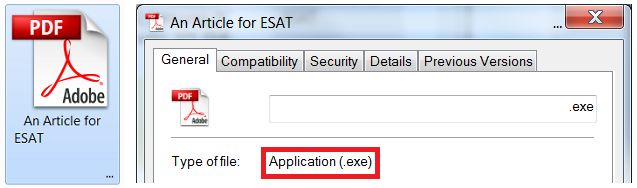
image10 This .rar file contained an .exe file disguised as a .pdf.  The file used the Adobe PDF icon, and contained a large number of spaces between the name and extension, to prevent Windows from displaying the extension.
   filepropertiesLeft: How the file was rendered in Windows; Right: Windows file properties dialog
Despite the file’s name, “An Article for ESAT,” the file did not display any such article, or any other content, when opened.

Analysis and Link to Hacking Team RCS

Summary

The file sent to ESAT appeared to be Hacking Team’s RCS spyware for the following two reasons:
  • The file communicated with a server that returned two SSL certificates.  The second certificate was issued by “RCS Certification Authority” / “HT srl”, and was similar to SSL certificates returned by two other servers apparently owned by Hacking Team.  The first certificate was similar to certificates returned by two other servers that appeared to be demonstration servers for Hacking Team’s RCS spyware. 
  • The file matched a signature that we had previously developed for RCS spyware.

Detailed Analysis

The hash of the file was:
sha256:   4a53db7b98aa000aeaa72d6a44004ef9ed3b6c09dd04a3e6015b62d741de3437
sha1:     b7438e699dd54f8b56fc779c1b8b08b1943d9892
md5:      53a9e1b59ff37cc2aeff0391cc546201
Shortly after opening the .exe file, it attempted to communicate with the server 46.4.69.25 on port 80.
inetnum:        46.4.69.0 - 46.4.69.31
netname:        HETZNER-RZ14
descr:          Hetzner Online AG
descr:          Datacenter 14
country:        DE
We probed the server and noticed that it returned two self-signed SSL certificates:39
IssuerSubjectFingerprint
/CN=default/CN=servera7c0eacd845a7a433eca76f7d42fc3fedf1bde3c
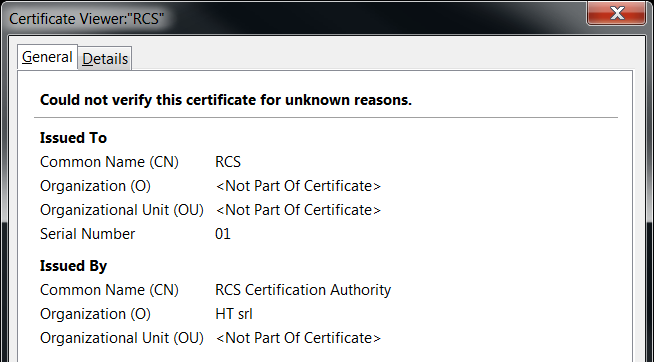
/CN=RCS Certification Authority /O=HT srl/CN=RCS Certification Authority /O=HT srl6500c243015a6ecc59f1272fec38eb0065d22063
The second certificate is issued by “RCS Certification Authority” / “HT srl”. image03 Hacking Team refers to their spyware as “RCS,” and identifies itself as “HT S.r.l.” on its website: image02
To confirm our hypothesis that these certificates were associated with Hacking Team, we searched historical SSL certificate data released by the Internet Census40 (443-TCP_SSLSessionReq) and by the University of Michigan’s zmap project.41  We found two servers returning the “RCS Certification Authority” / “HT srl” certificate that were in the following range:
inetnum:        93.62.139.32 - 93.62.139.47
netname:        FASTWEB-HT
descr:          HT public subnet
country:        IT
person:         GIANCARLO RUSSO
address:        VIA DELLA MOSCOVA 13
address:        MILANO MI
address:        IT
phone:          +39 0229060603
The address and phone number on the range matches those on Hacking Team’s website.  A Giancarlo Russo is listed as the COO of Hacking Team on LinkedIn.42  Thus, we believe that Hacking Team controls this range of IP addresses.
The two servers in this range that returned similar certificates to the server in the ESAT spyware were:
93.62.139.39 on 6/28/2012:
IssuerSubjectFingerprint
/CN=RCS Certification Authority /O=HT srl/CN=rcs-castoredeee895bf1f68e97cb997d929e0f991ecec6ab29
/CN=RCS Certification Authority /O=HT srl/CN=RCS Certification Authority /O=HT srl1e8e8806aa605544cda2bbb906b5d0cc7fb6fff7
93.62.139.42 on 8/12/2012:
IssuerSubjectFingerprint
/CN=RCS Certification Authority /O=HT srl/CN=rcs-polluce277fdf33df7baca54ce8336982db865d9f38f514
/CN=RCS Certification Authority /O=HT srl/CN=RCS Certification Authority /O=HT srle8d5f17d142768abe2ed835d5a61d99602ab082b
Because these IP addresses were registered to Hacking Team, we believe that the presence of a certificate apparently issued by “RCS Certification Authority” / “HT srl” is indicative of a server for Hacking Team’s RCS spyware. The Internet Census (443-TCP_SSLSessionReq) also recorded two instances of a server returning a certificate that matched the “default” / “server” certificate returned by the server in the ESAT spyware, along with an incomplete certificate for “rcs-demo.hackingteam.it”.  This server was used by an RCS spyware sample found in VirusTotal.43  This certificate was returned by 168.144.159.167 on 12/14/2012, and by 94.199.243.39 on 12/14/2012.  This is a further indication that the server in the spyware targeting ESAT is a Hacking Team RCS server.
The file itself also matched a signature we had previously developed for RCS spyware.

for entire article clik here
https://citizenlab.org/2014/02/hacking-team-targeting-ethiopian-journalists/

Sunday, September 8, 2013

Thursday, September 5, 2013

   “የሚሊዮኖች ድምፅ ለነፃነት” የ3ወር መርሃ-ግብር በታላቅ ሰላማዊ ሰልፍ ይጠናቀቃል!

አንድነት ለዴሞክራሲና ለፍትሕ ፓርቲ (አንድነት)
UNITY FOR DEMOCRACY AND JUSTICE PARTY (UDJ)
 “የሚሊዮኖች ድምፅ ለነፃነት” የ3ወር መርሃ-ግብር በታላቅ ሰላማዊ ሰልፍ ይጠናቀቃል!
 በአንድነትና በ33ቱ ፓርቲዎች በጋራ የተሠጠ ጋዜጣዊ መግለጫ
                                                አንድነት ለዴሞክራሲና ለፍትህ ፓርቲ(አንድነት) ሰላማዊ የፖለቲካ ትግል እንቅስቃሴ የበለጠ ተጠናክሮ ህዝቡ የትግሉ መሪ ተዋናይና ባለቤትነት እንዲረጋገጥ ላለፉት ሶስት ወራት ፓርቲያችን ባስቀመጠው ስትራቴጂ እቅድ መሠረት ሰፊ ህዝባዊ ንቅናቄ ሲያደርግ ቆይቱዋል፡፡
በሃገራችን ዘርፈ ብዙ ችግሮች ማለትም ፖለቲካዊ፤ ማህበራዊና ኢኮኖሚያዊ እንዲሁም የዜጎች ሰብአዊና ዴሞክራሲያዊ መብቶች መረገጥ ፓርቲያችን “የሚሊዮኖች ድምፅ ለነፃነት” በሚል ሰኔ 13ቀን 2005 በይፋ ለጀመረው ሕዝባዊ ንቅናቄ ፖለቲካዊ ምክንያቶች ናቸው፡፡
ሕዝባዊ ንቅናቄው በእቅድ መመራት ከመጀመሩ በፊት ሀገራችን የምትገኝበትን ነባራዊ ሁኔታና የህዝባችን ተጨባጭ ኑሮ ላይ ጥናት በማድረግ የመፍትሄ አማራጮችን ማቅረቡ የፓርቲያችን አብይ ጥያቄ ሆኖ መገኘቱም የንቅናቄውን ወቅታዊነት ያገናዘበ አድርጎታል፡፡
በእቅዳችን መሰረት በመላው ሃገሪቱ ለመጀመሪያው ዙር በተመረጡ ቦታዎች ያደረግናቸው ህዝባዊ ስብሰባዎችና ሰላማዊ ሰልፎች በአባሎቻችን፤ በደጋፊዎቻችንና በህዝባችን ጠንካራ ትግልና መስዋእትነት ንቅናቄው የተሳካ ሲሆን ፓርቲያችን ለተከፈለው ዋጋ ሁሉ አድናቆቱን ይገልፃል፡፡
በገዢው ፓርቲ ካድሬዎች በመታገዝ የፀጥታ ኃይሎች እንቅስቃሴዎቻችንን ለማጨናገፍ ከህግና ሥርዓት ውጪ ማስፈራራት፤ ማሸማቀቅ፤እስራትና ድብደባ በአባሎቻችን ላይ ሰብአዊነት በጎደለው ሁኔታ ተፈፅሞባቸዋል፡፡ የቅስቀሳ ቁሳቁስም በአካባቢ የፀጥታ ሰራተኞች ተዘርፈውብናል፡፡ እንዲሁም ህዝብ በነፃ አስተሳሰብ አማራጩን እንዳይከተል በአካባቢ ካድሬዎችና አመራሮች ማስፈራራትና ዛቻ ደርሶበታል፡፡ መርሃ ግብሩም ከተፈፀመ በኃላም ቢሆን ህዝባዊ ንቅናቄውን የተቀላቀሉ ዜጎቻችን በመኖሪያ ቀያቸው ሰርቶ የማደርና በነፃነት የመኖር መብታቸው አደጋ ላይ ነው፡፡
በተንቀሳቀስንባቸው አካባቢዎች ሁሉ ገዢው ፓርቲ ከህዝብ የተነጠለ መሆኑንና ህዝቡን እየመራሁ ነው የሚለው ህዘብን በማሸማቀቅ እንደሆነ መገንዘብ ችለናል፡፡ ከህግ ውጭ የገጠሙን መንግስታዊ ተፅእኖዎች ሁሉ ነፃነቱን በተነፈገውና በለውጥ ፈላጊው ህዘባችን ህዝባዊ እምቢተኝነት ተልኮአችን ሊሳካ ችልዋል፡፡
የሚሊዮኖችን ድምፅ ለማሰባሰብ እየተደረገ ያለው እንቅስቃሴም በሀገር ውስጥና በውጭ ሀገር ያሉ ዜጎቻችን በንቃትና በቁጭት የተሳተፍበት በመሆኑ አመርቂ ነው ማለት ይቻላል፡፡ ፊርማ የማሰባሰቡ መርሃ ግብር የሚቀጥል ይሆናል፡፡
የህዝባዊ ንቅናቄው የመጀመሪያው ዙር መርሃ ግብር በመዲናችን አዲስ አበባ ከተማ መስከረም 5ቀን 2006 በሚደረገው ታላቅ ህዝባዊ ሰላማዊ ሰልፍ ይጠናቀቃል ተብሎ ይጠበቃል፡፡ ይህ ታላቅ ሰላማዊ ሰልፍ እስካሁን ካደረግናቸው ህዝባዊ ንቅናቄዎች ልዩ የሚያደርገው የ33ቱ ተቃዋሚ ፓርቲዎች ይሁንታ ያገኘና ሰላማዊ ሰልፉን በባለድርሻነት የተሳተፉበት መሆኑ ነው፡፡
በአንፃሩ ገዢው ፓርቲ እስካሁን ካወጣቸው አፋኝ ህጎች በተጨማሪ ከቅርብ ጊዜ ወዲህ ተጠናክሮ የመጣውን ህዝባዊ የፖለቲካ ተቃውሞ የበለጠ ለመደፍጠጥ አሳሪ ደንቦች ለማውጣት የአዲስ አበባ ከተማ አስተዳደር እየተንቀሳቀሰ ለመሆኑ ከገጠመን መልካም አስተዳደር እጦት መገንዘብ ችለናል፡፡
የአንድነት ፓርቲና የ33ቱ ፓርቲዎች በጋራ በጠሩት በዚህ ታላቅ ሰላማዊ ሰልፍ ህዝቡ በነቂስ ወጥቶ የነፃነት ድምፁን እንዲያሰማ ጥሪያችንን እናቀርባለን፡፡
                                                     “የሚሊዮኖች ድምፅ ለነፃነት”

Tuesday, August 27, 2013

                                                       አንድነት ምሽት
 አጋርነት ለአንድነት የአእላፋት ፊርማ እነሆ የቶሮንቶና አካባቢው ኢትዮጵያዊያን የአንድነት ለዴሞክራሲና ለፍትህ ፓርቲን ወቅታዊ ዘመቻ በመደገፍ የአጋርነት ምሽት አዘጋጅተዋል
ቀን፡ ቅዳሜ ኦገስት 31፡ ከምሽቱ 6 ሰዓት ጀምሮ
ቦታ፡ 2050 Danforth Avenue፡ ሂሩት የመዝናኛ አዳራሽ
በእለቱ የአንድነት ለዴሞክራሲና ፍትህ ዴሞክራሲ ፓርቲ ሊቀመንበር አቶ ግርማ ሰይፉ በስካይፕ ንግግር ያደርጋሉ፡ አጫጭር የስነጽሁፍ ስራዎች ይቀርባሉ።
ለተጨማሪ መረጃ፡ በስ.ቁ.፡ 416 422 2962
በኢሜል፡unityforhumanrights@gmail.com

Saturday, August 24, 2013

Thursday, July 18, 2013

የሚሊዮኖች ድምፅ ለነፃነት ህዝባዊ ንቅናቄ ግብረ ኃይል ቀጣይ እቅዱን ይፋ አደረገ

July 18, 2013

የአንድነት ፓርቲ የሚሊዮኖች ድምፅ ለነፃነት ህዝባዊ ንቅናቄ ግብረ ኃይል ዛሬ ሐምሌ 11,2005 ዓ.ም ከረፋዱ 4 ሰዓት ባደረገው መደበኛ ስብሰባ ቀጣይ የህዝባው ንቅናቄ ዕቅዱን አፅድቋል፡፡
Millions of voices for freedom - UDJበዚሁም መሰረት በሚቀጥሉት የሀገራችን ከተሞች ህዝባዊ ስብሰባዎችንና ታላላቅ ሰላማዊ የተቃውሞ ሰልፎችን ጠርቷል፡፡ በየክልሉ ያሉ የአንድነት ፓርቲ ድርጅታዊ መዋቅሮች ለፓርቲው ባቀረቡት ጥያቄ መሰረት ግብረኃይሉ ያቀዳቸው ህዝባዊ የተቃውሞ ሰላማዊ ሰልፎች ከአዲስ አበባ አስቀድሞ በክልል ከተሞች ለማድረግ የተወሰነ ሲሆን የህዝባዊ ንቅናቄው ማጠቃለያ የሚሆነው መስከረም አምስት ቀን 2006ዓ.ም በአዲስ አበባ የሚደረገው ታላቅ ሰላማዊ የተቃውሞ ሰልፍ ይሆናል፡፡ ግብረ ኃይሉ መስከረም 5, 2006 ዓ.ም ሰላማዊ ሰልፍ ለማድረግ ያቀደው ሰላማዊ ታጋዮቹ አንዱአለም አራጌና ጋዜጠኛ እስክንድር ነጋ የታሰሩበትን ሁለተኛ አመት ለመዘከር እንደሆነ ታውቋል፡፡
ህዝባዊ ሰብሰባ የሚደረግባቸው ከተሞችና  ቀኖቻቸ
========================
ሐምሌ 21 አዲስ አበባ በሁለት ቦታዎች
ሐምሌ 28 አዲስ አበባ በሁለት ቦታዎች
ሐምሌ 28 ወላይታ ሶዶ
ሐምሌ 28 መቐለ
ነሀሴ 5 አዲስ አበባ በሁለት ቦታዎች
ነሀሴ 26 ድሬደዋ
ነሀሴ 26 አዋሳ
ነሀሴ 26 አምቦ
ነሀሴ 26 ደብረማርቆስ
ህዝባዊ ሰልፎች የሚደረጉባቸው ከተሞች
========================
ሐምሌ 28 ባህር ዳር
ሐምሌ 28 ጅንካ
ሐምሌ 28 አርባ ምንጭ

ነሃሴ 12 አዳማ
ነሃሴ 12 ባሌ
ነሃሴ 12 ወሊሶ
ነሃሴ 12 ፍቼ
ነሃሴ 26 ጋምቤላ
ነሃሴ 26 አሶሳ
መስከረም 5 አዲስ አበባ

Thursday, June 27, 2013


ሕዝባዊ ንቅናቄያችን የመጀመሪያውን ሰላማዊ ሰልፍ በጎንደር ያደርጋል!!

ከአንድነት ለዴሞክራሲና ለፍትሕ ፓርቲ(አንድነት) የተሰጠ መግለጫ

አንድነት ፓርቲ የሶስት ወራት ህዝባዊ ንቅናቄ የትግል ስልት በመንደፍ እንቅስቃሴ መጀመሩን በይፋ መግለጹ አይዘነጋም፡፡ የህዝባዊ ንቅናቄው የመጀመሪያ የአደባባይ ላይ ሰላማዊ ሰልፍም ሰኔ 30/10/2005 በጎንደር ከተማ ይደረጋል፡፡ የአገሪቱ ህገ መንግስት በሚደነግገው መሰረትም ፓርቲው ከህዝቡ ጋር የሚያደርገውን ሰላማዊ ሰልፍ በጎንደር ከተማ ማወቅ ለሚገባው አካል የፓርቲያችን መዋቅር አሳውቆ ወደ ቅስቀሳ ገብተዋል፡፡

በሰላማዊ ሰልፉ ላይም በጎንደር እየተፈጸመ ያለውን የመልካም አስተዳደር ችግር፣ ሰዎችን በአደራ ማሰር፣ ለሱዳን ከህዝቡ እውቅና እና ፈቃድ ውጪ መሬት መሰጠቱን፣ በነጋዴዎች ላይ የሚፈጸመውን ኢ-ፍትሃዊ አሰራር፣ ለስራ የደረሱ ወጣቶች የፓርቲ አባል ካልሆኑ በስተቀር ስራ የማያገኙበትን ሁኔታ፣ በዘር ላይ የተመሰረተን ማፈናቀልና የኑሮ ውድነትን አስመልክቶ ህዝቡ የተቃውሞ ድምጹን በነቂስ ወጥቶ ያሰማል፡፡ እንዲሁም የጸረ ሽብር ህጉ የዜጎችን ህገ መንግስታዊ መብት የሚጥስ በመሆኑ እንዲሰረዝ ይጠየቃል፡፡ ብዙ ሺ የከተማው ኗሪዎችም የተቃውሞ ፊርማቸውን ያኖራሉ ተብሎ ይጠበቃል፡፡

ሰላማዊ ሰልፉን በጎንደር ከሚገኙ የፓርቲው አባላትና አመራሮች ጋር የተሳካ ለማድረግ አዲስ አበባ ከሚገኘው ዋና ቢሮ አስተባባሪ አባላት የተላኩ ሲሆን የቅስቀሳ ስረቸውንም ጀምረዋል፡፡ ቅዳሜም ሁለተኛው ቡድን ወደ ጎንደር ያቀናል፡፡ የፓርቲያችን ስራ አስፈጻሚ፣ የብሄራዊ ምክር ቤትና በየመዋቅሩ ያሉ አባላቶቻችን በሰላማዊ ሰልፉ ላይ ለመገኘት ወደ ጎንደር ያመራሉ፡፡

ሰላማዊ ሰልፉ ከላይ በተጠቀሰው ቀን ከጠዋቱ 3፡00 ሰዓት ጀምሮ ጎንደር ከሚገኘው የአንድነት ፓርቲ ቅርንጫፍ ቢሮ ተነስቶ ወደ መስቀል አደባባይ በማምራት በመስቀል አደባባይ በሚደረግ ልዩ ልዩ ፕሮግራም የሚጠናቀቅ ይሆናል፡፡ በጎንደር መስቀል አደባባይ ለሚገኘው ህዝብ የፓርቲው ከፍተኛ አመራሮችና ታዋቂ ግለሰቦች የሰላማዊ ሰልፉን ዓላማ የሚገልፅ ንግግር ያደርጋሉ፡፡

ፓርቲያችን አንድነትም የሦስት ወር ሕዝባዊ ንቅናቄያችንን ይፋ ካደረግን ጀምሮ ሕዝቡ፣ የፖለቲካ ፓርቲዎች፣ የሲቪክ ተቋማት፣ በሀገር ውስጥና በውጭ ያሉ የሚዲያ ተቋማት፣ የፀረ-ሽብር ህጉ እንዲሰረዝ ፔቲሽን ለፈረሙትና ከጎናችን ለቆሙ ታዋቂ ግለሰቦች በአክብሮት ምስጋና እያቀረብን አሁንም ድጋፉ ተጠናክሮ እንዲቀጥል ሀገራዊ ጥሪያችንን እናቀርባለን፡፡

የሚሊዮኖች ድምፅ ለነፃነት!!!

አንድነት ለዴሞክራሲና ለፍትሕ ፓርቲ (አንድነት)

ሰኔ 20 ቀን 2005 ዓ.ም

አዲስ አበባ

Saturday, April 20, 2013

Bureau of Democracy, Human Rights and Labor Country Reports on Human Rights Practices for 2012 Ethiopia

Ethiopia is a federal republic. On August 20, Prime Minister Meles Zenawi died. The ruling Ethiopian People’s Revolutionary Democratic Front (EPRDF) elected then deputy prime minister Hailemariam Desalegn to take Meles’s place as chairman of the party. The EPRDF subsequently nominated him for the post of prime minister. On September 21, parliament elected Hailemariam as prime minister. In national parliamentary elections in 2010, the EPRDF and affiliated parties won 545 of 547 seats to remain in power for a fourth consecutive five-year term. Although the relatively few international officials allowed to observe the elections concluded technical aspects of the vote were handled competently, some also noted that an environment conducive to free and fair elections was not in place prior to the election.
Security forces generally reported to civilian authorities; however, there were instances in which special police and local militias acted independently of civilian control.
The most significant human rights problems included restrictions on freedom of expression and association through politically motivated trials and convictions of opposition political figures, activists, journalists, and bloggers, as well as increased restrictions on print media. In July security forces used force against and arrested Muslims who protested against alleged government interference in religious affairs. The government continued restrictions on civil society and nongovernmental organization (NGO) activities imposed by the Charities and Societies Proclamation (CSO).
Other human rights problems included arbitrary killings; allegations of torture, beating, abuse, and mistreatment of detainees by security forces; reports of harsh and at times life-threatening prison conditions; arbitrary arrest and detention; detention without charge and lengthy pretrial detention; a weak, overburdened judiciary subject to political influence; infringement on citizens’ privacy rights, including illegal searches; allegations of abuses in the implementation of the government’s “villagization” program; restrictions on academic freedom; restrictions on freedom of assembly, association, and movement; alleged interference in religious affairs; limits on citizens’ ability to change their government; police, administrative, and judicial corruption; violence and societal discrimination against women and abuse of children; female genital mutilation/cutting (FGM/C); exploitation of children for economic and sexual purposes; trafficking in persons; societal discrimination against persons with disabilities; clashes between ethnic minorities; discrimination against persons based on their sexual orientation and against persons with HIV/AIDS; limits on worker rights; forced labor; and child labor, including forced child labor.
Impunity was a problem. The government, with some reported exceptions, generally did not take steps to prosecute or otherwise punish officials who committed abuses other than corruption.
Factions of the Ogaden National Liberation Front (ONLF), an ethnically based, violent, and fragmented separatist group operating in the Somali Region, were responsible for abuses. Members of the separatist Afar Revolutionary Democratic Union Front (ARDUF) claimed responsibility for a January attack on a group of foreign tourists in the Afar Region.
http://www.state.gov/j/drl/rls/hrrpt/humanrightsreport/index.htm#wrapper

Thursday, January 31, 2013

2013 Human Rights Watch Report (Ethiopia)

January 31, 2013 

የ 2013 የዓለም የሰብአዊ መብቶች ሁኔታ ሪፖርት፡- ኢትዮጵያ

ኢትዮጵያን ለረጅም ዓመታት በጠቅላይ ሚኒስትርነት የመሩትና ሰፊ ስልጣን የነበራቸው መለስ ዜናዊ በነሃሴ ወር በድንገት መሞት በሃገር ውስጥም ሆነ በኢትዮጵያ ዓለማቀፍ አጋሮች ዘንድ የሀገሪቱን ፖለቲካዊ ሽግግር የሚመለከቱ ጥያቄዎችንና አጠራጣሪ ሁኔታዎችን አስነስቶ ነበር።በኢትዮጵያ ያለው የሰብአዊ መብቶች አያያዝ በተለይ ካለፉት ጥቂት ዓመታት ወዲህ እየከፋ ሄዷል።አዲሱ ጠቅላይ ሚኒስትር ኃይለማርያም ደሳለኝ በመስከረም ወር ስልጣኑን የተረከቡ ቢሆንም መንግስት በርሳቸው አመራር ሰብአዊ መብቶችን የሚመለከቱ ለውጦች ያደርግ ወይስ አያደርግ እንደሆነ ገና የሚታይ ነው።
እ.ኤ.አ በ2012ም የኢትዮጵያ ባለስልጣናት መሰረታዊ የሆኑትን ሃሳብን በነጻ የመግለጽ፣ የመደራጀት እና የመሰብሰብ መብቶች በጥብቅ መገደባቸውን ቀጥለዋል።ለኣሻሚ ትርጉሞች በተጋለጠውና በ2002 ዓ.ም በወጣው የሀገሪቱ የጸረ ሽብርተኝነት ሕግ 30 ጋዜጠኞችና የተቃዋሚ ፖለቲካ ፓርቲ አባላት ተከሰው ተፈርዶባቸዋል።በዋና ከተማዪቱ አዲስ አበባ እና በኦሮሚያ ክልል የእስልምና እምነት ተከታዮች ላካሄዷቸው የተቃውሞ ሰልፎች የጸጥታ ሃይሎች የሰጡት ምላሽ የዘፈቀደ አፈሳ፣ እስር እና ድብደባ ነበር።
የኢትዮጵያ መንግስት በአምስት ክልሎች የሚኖሩ የገጠር ነዋሪዎችን የተሻለ የመሰረታዊ ግልጋሎቶች አቅርቦት ሊያገኙ ወደሚችሉባቸው አካባቢዎች ለመውሰድ በሚል ምክንያት 1.5 ሚሊዮን የገጠር ነዋሪዎችን መልሶ ለማስፈር የሚያካሂደውን የሰፈራ ፕሮግራም ቀጥሎበታል።በጋምቤላ ክልል የሚገኙ በርካታ ነዋሪዎች ከፍላጎታቸው ውጭ በሃይል እንዲፈናቀሉ በመደረጋቸው ለከፍተኛ ችግሮች ተጋልጠዋል። ከዚህ በተጨማሪም መንግስት ለሚያካሂደው ሰፊ የስኳር ልማት መሬት ለማስለቀቅ ሲባል በኢትዮጵያ የታችኛው ኦሞ ሸለቆ ነዋሪ የሆኑትን አርብቶ አደር ማህበረሰቦች ከመኖሪያቸው እንዲፈናቀሉ እያደረገ ነው።
ሃሳብን በነጻ የመግለጽ፣የመደራጀት እና የመሰብሰብ መብቶች

መንግስታዊ ያልሆኑ ደርጅቶችን እንቅስቃሴ ለመቆጣጠር  የበጎ አድራጎት ደርጅቶች እና ማህበራት አዋጅ እንዲሁም የጸረ ሽብርተኝነት ሕግ በ2002 ዓ.ም ከታወጁ ወዲህ በኢትዮጵያ ሃሳብን በነጻ የመግለጽ፣የመሰብሰብ እና የመደራጀት መብቶች ከፍተኛ ገደብ ተጥሎባቸዋል። እነዚህ ሁለት ሕጎች መንግስት በሲቪል ማህበረሰብ መሪዎች፣በጋዜጠኞች እና በሌሎችም የመንግስትን ፖሊሲ በሚተቹና መንግስት እንዲነሱ በማይፈልጋቸው ጉዳዮች ላይ ሃሳባቸውን በሚገልጹ ሰዎች ላይ ካካሄደው ሰፊ እና የማያቋርጥ ማዋከብ፣ዛቻ እና ማስፈራራት ጋር ተዳምሮ ያስከተሉት  ውጤት የከፋ ነው።
ኢትዮጵያ ውስጥ እጅግ የጎላ እንቅስቃሴ ያደርጉ የነበሩ የሰብአዊ መብቶች ድርጅቶች እንቅስቃሴዎቻቸውን በከፍተኛ ሁኔታ እንዲቀንሱ ወይም ሰብአዊ መብቶችን የሚመለከቱ ጉዳዮችን ከስራ ዝርዝራቸው ውስጥ እንዲያወጡ የተገደዱ ሲሆን ቁጥራቸው ያልታወቀ ድርጅቶችም ጭራሹኑ ተዘግተዋል። በደረሰባቸው ማስፈራሪያ ምክንያት ሰፊ ልምድና መልካም ስም የነበራቸው ብዙ የሰብአዊ መብቶች ተሟጋቾች ሃገሪቱን ለቀው ሄደዋል። አሁን ሰፍኖ የሚገኘው ሁኔታ ለነጻ ፕሬስ እንቅስቃሴም እንዲሁ የተመቸ አይደለም።ባለፉት አስር ዓመታት በደረሰባቸው ዛቻ እና ማስፈራራት ሳቢያ ሃገራቸውን ለመልቀቅ በተገደዱ ጋዜጠኞች ቁጥር በዓለም ኢትዮጵያ ቀዳሚዋ ናት። የጋዜጠኞች መብት ተሟጋች የሆነው ድርጅት ሲፒጄ እንደሚገልጸው ቢያንስ 79 ጋዜጠኞች ሃገራቸውን ለቀው ለመሰደድ ተገደዋል።
የጸረ ሽብርተኝነት አዋጁ፣ ተቃዋሚ ናቸው ተብለው የሚታሰቡ ሰዎችን ዒላማ ለማድረግ፣ተቃውሞን ለማፈን እና ጋዜጠኞችን ዝም ለማሰኘት ስራ ላይ እየዋለ ነው። እ.ኤ.አ በ2012 ዓ.ም 30 የፖለቲካ መሪዎች፣ የተቃዋሚ ፓርቲ አባላት እንዲሁም ጋዜጠኞች በግልጽ ባልተብራሩ የሽብርተኝነት ወንጀሎች ተከሰው ተፈርዶባቸዋል።ከ2011 ጀምሮ ባለው ጊዜ ውስጥ 11 ጋዜጠኞች በዚሁ ሕግ ተከሰው ተፈርዶባቸዋል።

ጥር 17 ቀን 2004 ዓ.ም አሁን የተዘጋው አውራምባ ታይምስ ጋዜጣ ምክትል አዘጋጅ በነበረው ውብሸት ታዬ እና የጋዜጣው ዓምደኛ በነበረችው ርዕዮት ዓለሙ ላይ በአዲስ አበባ የሚገኝ ፍርድ ቤት የ 14 ዓመታት እስር ፈርዶባቸዋል።የርዕዮት ዓለሙ ፍርድ በኋላ በይግባኝ ወደ አምስት ዓመታት የተቀነሰ ሲሆን ከቀረቡባት ክሶች ውስጥም አብዛኞቹ ተሰርዘዋል።
ከፍተኛ ክብር ያለውን የፔን አሜሪካ ፍሪደም ቱ ራይት ሽልማት በሚያዝያ ወር 2004 ዓ.ም ያሸነፈው አንጋፋው ጋዜጠኛ እና ብሎገር እስክንድር ነጋ ሐምሌ 6 ቀን 2004 ዓ.ም ከሌሎች ጋዜጠኞችና የተቃዋሚ ፓርቲ አባላት ጋር በቀረበበት ክስ የ 18 ዓመታት እስራት ተፈርዶበታል። በስደት ላይ የሚገኙት ጋዜጠኞች አብይ ተክለማርያም እና መስፍን ነጋሽም እስካሁን ድረስ ጋዜጠኞች ላይ ብቻ ተግባራዊ በተደረገው የጸረ ሽብርተኝነት ሕጉ አንቀጽ መሰረት ጥፋተኛ ተብለው እያንዳንዳቸው የ 8 ዓመታት እስራት ተፈርዶባቸዋል። በይፋ ተመዝግቦ የሚንቀሳቀሰው ተቃዋሚ ፓርቲ አንድነት ለፍትሕ እና ለዲሞክራሲ አባል የሆነው አንዷለም አራጌ በስለላ፣ሕገ መንግስታዊ ስርዓቱን በመናድ እንዲሁም የሽብር ተግባር ለመፈጸም ምልመላ እና ስልጠና በማካሄድ ወንጀሎች ጥፋተኛ ተብሎ የዕድሜ ልክ እስራት ተፈርዶበታል።
በመስከረም ወር 2004 ዓ.ም የፌደራል ከፍተኛ ፍርድ ቤት የእስክንድር ነጋ እና በስደት ላይ የሚገኘው ጋዜጠኛ አበበ በለው  እንዲሁም የተቃዋሚ ፖለቲካ ፓርቲ አባሉ አንዷለም አራጌ ንብረቶች እንዲወረሱ ትዕዛዝ ሰጥቷል።
 
 click the link for full reporthttp://www.hrw.org/world-report/2013/country-chapters/112447

Sunday, December 30, 2012

Fighting for freedom with microphone and camera

Freedom for his homeland. That’s the dream of journalist Fasil Yenealem. From a ramshackle self-built studio in Amsterdam he’s striving to do what he can no longer do from Ethiopia: bring independent news to his country.

The Ethiopian government keeps a tight control on the country’s media, and it’s almost impossible to access reliable information. Fasil’s criticism of Prime Minster Meles Zenawi led to a prison sentence in 2005, and he fled to the Netherlands in 2007.

Once here, he and his colleagues established Ethiopian Satellite Television (ESAT) to continue this work. His efforts saw him sentenced to life imprisonment in absentia by an Addis Ababa court earlier this year.

Fasil gathers his information from sources within Ethiopia and operates without any sort of government support, surviving mostly on donations from other Ethiopian exiles. He is convinced of the vital importance of freedom of expression and believes this will one day be possible in Ethiopia. Fasil is not sure he’ll live to see it himself, but he's confident others will pick up the struggle where he leaves off.


Thursday, December 6, 2012

Human Rights watch
World Report 2012: Ethiopia
Events of 2011
Downloadable Resources: 
Ethiopian authorities continued to severely restrict basic rights of freedom of expression, association, and assembly. Hundreds of Ethiopians in 2011 were arbitrarily arrested and detained and remain at risk of torture and ill-treatment.
Attacks on political opposition and dissent persisted throughout 2011, with mass arrests of ethnic Oromo, including members of the Oromo political opposition in March, and a wider crackdown with arrests of journalists and opposition politicians from June to September 2011.
The restrictive Anti-Terrorism Proclamation (adopted in 2009) has been used to justify arrests of both journalists and members of the political opposition. In June 2011 the Ethiopian House of Federations officially proscribed two armed groups—the Ogaden National Liberation Front (ONLF) and the Oromo Liberation Front (OLF) and one opposition party, Ginbot 7—labeling them terrorist organizations.

Political Repression, Pretrial Detention, and Torture
In March 2011, authorities arrested more than 200 members and supporters of registered Oromo opposition parties—the Oromo Federal Democratic Movement (OFDM) and the Oromo People’s Congress (OPC)—during mass roundups. Those arbitrarily arrested and detained included former members of parliament, long-serving party officials, and candidates in the 2010 regional and parliamentary elections. They were publicly accused of being involved with the banned OLF; at least 89 have been charged with a variety of offenses, some relating to terrorism.
On August 27 Bekele Gerba, deputy chairman of OFDM; Olbana Lelisa, a spokesman for OPC; and seven other opposition party members  were arrested on charges of involvement with the OLF. They were held in pre-trial detention at the Federal Police Crime Investigation Department, also known as Maekelawi, where torture is reportedly common.  At least 20 other ethnic Oromo were arrested in this same sweep.
On September 8 popular actor Debebe Eshetu was arrested and accused of belonging to the banned opposition party Ginbot 7. The following week, on September 14, Andualem Aragie, vice-chairman of the opposition party Unity for Democracy and Justice (UDJ), two other active members of UDJ, and the general secretary of another opposition party, the Ethiopian National Democratic Party (ENDF), were arrested in Addis Ababa, the capital, on similar accusations.

Human Rights Watch continues to receive credible reports of arbitrary detention and serious abuses of civilians alleged to be members or supporters of ONLF. These civilians were being held in detention facilities in Ethiopia’s Somali region. 
Long-term pre-trial detention without charge, often without access to counsel, is common, notably under the Anti-Terror law, which allows police to request additional investigation periods of 28 days each from a court before filing charges, for up to four months. Human Rights Watch is aware of at least 29 opposition party members, journalists, and an actor who at this writing were currently held in remand detention under the Anti-Terror law.
No independent domestic or international organization has access to all of Ethiopia's detention facilities; it is impossible to determine the number of political prisoners and others arbitrarily detained or their condition.

Freedom of Expression and Association
What little remains of the private independent media and foreign media faced further attacks and restrictions during 2011. Self-censorship is rampant. Journalists working for the few remaining “independent” domestic newspapers have faced regular harassment and threats. Several journalists were arbitrarily arrested and detained in 2011.

On June 19 and 21 respectively Woubshet Taye of Awramba Times and Reeyot Alemu of Feteh, journalists for two newspapers often critical of the government, were arrested, along with seven other individuals, including two ENDP members, and accused of conspiring to commit terrorist acts. After almost three months of detention, without access to their lawyers, the two were charged on September 6 of several counts of terrorism. Charges were also leveled against Elias Kifle, editor of the online Ethiopian Review, in absentia. One ENDP member, Zerihun Gebre-Egzabiher, was also charged.
On September 14, 2011, veteran journalist Eskinder Nega was arrested on charges of involvement with Ginbot 7. Eskinder, like Elias Kifle, was among the 121 opposition party members, journalists, and human rights activists arrested following the 2005 elections, and accused of treason and other related crimes, and among the 76 who were later convicted. He has faced ongoing harassment since his release and has been repeatedly denied a license to practice journalism.
Journalists working for foreign media have not been spared from these attacks. In September 2011 the Ethiopian correspondent of the Kenyan Daily Nation, Argaw Ashine, was forced to flee the country after he was named in an unedited WikiLeaks United States diplomatic cable regarding planned attacks, by the governmental Communication Affairs Office (GCAO), on journalists from the Addis Neger newspaper. The GCAO and Federal Police summoned Argaw for questioning regarding his sources within the GCAO. Addis Neger editors and journalists were forced to close their newspaper and flee the country in November 2009 after threats of arrest under the Anti-Terror law.
Independent reporting on the conflict-affected areas of the Somali region remains severely restricted. On July 1, 2011, two Swedish journalists who had entered Ethiopia in order to report on the situation were arrested. They were held without charge for two months in Jijiga and Addis Ababa before being charged on September 6 with terrorism. Their trial continued at this writing.
Restrictions on Human Rights Reporting
The restrictive Charities and Societies Proclamation, adopted in 2009, which prohibits organizations receiving more than 10 percent of their funding from abroad from carrying out human rights and governance work, continues to severely hamper basic rights monitoring and reporting activities. Two former leading rights organizations, the Ethiopian Women’s Lawyers Association (EWLA) and the Human Rights Council (HRCO, formerly EHRCO), have had to slash their budgets, staff, and operations. Their bank accounts, which the government arbitrarily froze in December 2009, remain frozen.

The government-affiliated Ethiopian Human Rights Commission lacks independence and is not yet compliant with the Paris Principles, which the United Nations General Assembly adopted in 1993 and which promote the independence of national human rights institutions. 
On August 27, 2011, an Amnesty International delegation to Ethiopia was ordered to leave the country following a series of meetings with members of the political opposition; two of these members were arrested after their meeting with Amnesty International. 

Discrimination in Government Services
 

In October 2010 Human Rights Watch published Development without Freedom: How Aid Underwrites Repression in Ethiopia, a report which documented discrimination in the administration of foreign donor-funded government services, including agricultural assistance, food-for-work programs, educational training opportunities, and civil-service reform programs. The report also showed how donor-funded facilities, such as schools and teacher training colleges, underwrite the indoctrination of civil servants and school children in political propaganda. Human Rights Watch’s research suggested that donors in the Development Assistance Group (DAG), including the US, Canada, the United Kingdom, and the European Union, were aware of such allegations, but were taking insufficient steps to investigate the misuse of their aid money.
DAG denied that aid was politicized, citing as evidence a UK Department for International Development-led report, “The Aid Management and Utilization Study,” which concluded that existing monitoring mechanisms would not detect politicization if it were occurring. That report also promised a second phase, a field investigation, which it said was crucial to establishing whether or not politicization was occurring on a broad scale. In April 2011 DAG told Human Rights Watch that this second phase, the field investigation, had been cancelled. A 2009 US diplomatic cable released by WikiLeaks said that the US embassy in Ethiopia was “keenly aware that foreign assistance … is vulnerable to politicization,” but that monitoring the problem, “risks putting the assistance programs themselves in jeopardy from a ruling party that has become confident that its vast patronage system is largely invulnerable.”

Key International Actors
International donor assistance continues to pour into Ethiopia, one of the world’s largest recipients of aid, but this has not resulted in greater international influence in ensuring government compliance with its human rights obligations. Conversely, donors appear to be reluctant to criticize the Ethiopian government’s human rights record so as not to endanger the continuity of their assistance programs.

Nonetheless, government spending remains hugely reliant (between 30 and 40 percent) on foreign assistance, and donors retain significant leverage that they could use to greater effect to insist on basic measures, such as the repeal or amendment of the Charities and Societies Proclamation and the Anti-Terrorism Proclamation, admission of UN special rapporteurs on human rights, the release of political prisoners, and better monitoring of foreign-funded programs to make sure they are not being used to bolster the ruling party.

Thursday, November 1, 2012

Reporter jailed in Ethiopia among women journalists honored

November 1, 2012  Los Angeles Times
 Reeyot Alemu missed an important dinner engagement in Beverly Hills.  But she had a good excuse.
The 31-year-old journalist is jailed in the notoriously brutal, rodent-infested Kaliti prison in Addis Ababa, the capital of Ethiopia. She’s two years into a five-year sentence for daring to write about poverty, opposition politics and gender equality.
The dinner she missed Monday was the annual awards ceremony, at the Beverly Hills Hotel, for the International Women’s Media Foundation, which celebrates courageous women journalists.
This year’s honorees included Alemu, whose detention will be reviewed next week by Ethiopia’s highest court, organizers said. There’s only modest reason to be hopeful, although the attention of the award could put pressure on the regime.
Even from prison, Alemu declined to be silent.
“Shooting the people who march through the streets demanding freedom and democracy; jailing the opposition party leaders and journalists… preventing freedom of speech, association and the press; corruption and domination of one tribe are some of the bad doings of our government,” she wrote in accepting one of three courage awards.
"I know that I would pay the price for my courage and I was ready to accept that price,” she wrote.
Another honoree, Khadija Ismayilova of Azerbaijan, was jolted into serious journalism by the death of investigative reporter Elmar Huseynov.
“He was shot — five bullets in the mouth,” Ismayilova said. “Shot dead in front of his door.”
Another colleague survived having his legs run over by a car and then being left for dead, simply for asking how a charity controlled by the president’s wife was funded. She decided that a pervasive silence of self-censorship about corruption had to be broken.
Ismayilova, 36, works for Radio Free Europe, which, as a foreign-based operation, may offer some protection from outright brutality. It didn’t stop powerful forces from installing hidden video equipment in her bedroom. Blackmailers threatened to post intimate footage of her and her boyfriend unless she backed off.
“I was surprised with my reaction,” she said. “I discovered that anger is bigger than fear.”
She continued her work, and the video was posted online — instantly making her a target for harm in the socially conservative Muslim country.
She kept working, and soon aired a story about how the president’s family benefited financially from an expensive vanity project — building the world’s tallest flagpole. Within six months, another regional autocrat built a pole two meters higher.
“I’m not chasing them,” she said of President Ilham Aliyev and his family, who’ve become the focus of her repeated reports on corruption. “Just whatever you did, their names pop out.”
She added: “I had like bodyguards for a couple of months, but I don’t need it. It doesn’t prevent anything. They are much more powerful than I am and they can do whatever they want. They can kill me if they want.
“So it doesn’t make sense to think about it. I do what I want to do…I will do my work.”
The third honoree, Asmaa al-Ghoul, a journalist/blogger from Gaza, gained widespread attention in 2007 when she published a critical letter to her uncle, a military leader of Hamas, the faction which controls Gaza. It was titled “Dear Uncle, Is This the Homeland We Want?”
The letter criticized him for forcing Islamic views on the population and using the family home to interrogate and beat members of the rival political group Fatah.
She’s been arrested and beaten twice by Hamas — once when she was writing about the Arab spring, and again about her desire for an independent Palestine under a united government.
In an interview, al-Ghoul said that Gaza suffers from three overlapping occupations: by Israeli forces who send helicopters overhead and drop bombs, and also by the oppression of the two main, rival Palestinian factions.
At Monday’s dinner, a lifetime achievement award went to Zubeida Mustafa of Pakistan, who is 70 and nearly blind, but continues to write. She was saluted as a woman who opened the doors of the newsroom to other women in her country.

Tuesday, August 21, 2012

The Rebel Leader and Ethiopian Prime Minister Meles Zenawi dead at 57


By JASON STRAZIUSO, Associated Press – ADDIS ABABA, Ethiopia (AP) — Meles Zenawi, Ethiopia's long-time ruler who held tight control over this East African country but was a major U.S counter-terrorism ally, died of an undisclosed illness after not being seen in public for weeks, Ethiopian authorities announced Tuesday. He was 57.
Meles died Monday just before midnight after contracting an infection, state TV said.
Hailemariam Desalegn, who was appointed deputy prime minister and minister of foreign affairs in 2010, became acting prime minister and will be sworn in as prime minister after an emergency meeting of parliament, said Bereket Simon, the communications minister. Parliament is controlled by Meles' ruling party and governing coalition, ensuring Hailemariam will be approved. No new elections will be scheduled, Bereket said.
Bereket did not say where Meles died, only that he was abroad for medical treatment. Officials had expected Meles to return to Ethiopia but a sudden complication reversed what had been a good recovery, he said.
A European Union spokesman said that Meles died in Brussels.
Meles hadn't been seen in public for about two months. In mid-July, after Meles did not attend a meeting of heads of state of the African Union in Addis Ababa, Ethiopia's capital, speculation increased that his health problems were serious. Ethiopian officials gave no details and said the prime minister was in "very good" health and would return to office soon, but international officials said quietly it was unlikely he would recover.
State TV on Tuesday showed pictures of Meles as classical music played in the background. Simon called the death shocking and devastating. The country's council of ministers declared a national day of mourning.
Opponents of Meles accuse him of killing and jailing opposition members and of rigging elections. Ethiopia's Somalia community in particular has suffered under Meles, who won his last election in 2010 with a reported 99 percent of the vote.
Jose Manuel Barroso, the president of the European Commission, offered his condolences to the Ethiopian people, praising Meles' development work and calling him "a respected African leader." But he also expressed concern about the state of democracy in the country.
"I sincerely hope that Ethiopia will enhance its path of democratization, upholding of human rights and prosperity for its people, and of further regional stabilization and integration," Barroso said in a statement.
Born on May 8, 1955, Meles became president in 1991 after helping to oust Mengistu Haile Mariam's Communist military junta, which was responsible for hundreds of thousands of Ethiopian deaths. Meles became prime minister in 1995, a position that is both the head of the federal government and armed forces.
The U.S. has long viewed Meles as a strong security partner and has given hundreds of millions of dollars in aid over the years. U.S. military drones that patrol East Africa — especially over Somalia — are stationed in Ethiopia. The U.S. goal for Somalia — a stable government free of radical Islamists — is in line with Ethiopia's hopes.
Though a U.S. ally, Ethiopia has long been criticized by human rights groups for the government's strict control, and Meles' legacy is likely to be mixed: positive on the economic development side and negative on the human rights side, said Leslie Lefkow, the deputy director for Human Rights Watch in Africa.
Meles brought Ethiopia out of a hugely difficult period following Mengistu's rule and made important economic progress, she said, but the ruling party has been too focused on building its own authority in recent years instead of building up government institutions.
"I think on the human rights side his legacy will be much more questionable. The country remains under a very tightly controlled one-party rule and this will be the challenge for the new leadership, to take advantage of the opportunity that his death presents in terms of bringing Ethiopia into a more human rights-friendly, reform-minded style of leadership," Lefkow said.
During Meles' election win in 2005, when it appeared the opposition was likely to make gains, Meles tightened security across the country, and on the night of the election he declared a state of emergency, outlawing any public gathering as his ruling party claimed a majority win. Opposition members accused Meles of rigging the election, and demonstrations broke out. Security forces moved in, killing hundreds of people and jailing thousands.
In 2010 Meles won another five years in office while receiving a reported 99 percent of the vote in an election that the U.S. and other international observers said did not meet international standards.
Meles was the leader of a political coalition known as the Ethiopian People's Revolutionary Democratic Front. He was also the longtime chairman of the Tigray People's Liberation Front and has always identified strongly with his party.
"I cannot separate my achievements from what can be considered as the achievements of the ruling party. Whatever achievement there might have been, it does not exist independent of that party," Meles once said when asked what he thought would be his legacy.
Under Meles, Ethiopia saw strong gains in the education sector with the construction of new schools and universities. Women gained more rights. And in the mid-2000s Ethiopia saw strong economic growth, which won Meles international praise. The International Monetary Fund in 2008 said Ethiopia's economy had grown faster than any non-oil exporting country in sub-Saharan Africa.
Despite those gains, Ethiopia remains heavily dependent on agriculture, which accounts for 85 percent of the country's employment. Per capita income is only about $1,000, or roughly $3 a day.
Though he won accolades for economic progress, human rights groups have long denounced Meles' government for its use of arbitrary detention, torture, and surveillance of opposition members inside Ethiopia. The ONLF, an opposition group that mostly consists of ethnic Somalis, has openly clashed with the government, including in 2007 when Ethiopia sent troops to Somalia to fight al-Shabab militants.
The ONLF said Tuesday that Meles' death is an opportunity for a new government to "initiate a new era of peace, stability, freedom and justice for the people of Ogaden and not to pursue the failed policies of the past."
At the end of 2006, Somalia's U.N.-backed government asked Ethiopia to send troops into Somalia to try to put down an Islamist insurgency. Ethiopian troops moved into the country and captured Mogadishu, but the Somali population rebelled against what it saw as an occupation and Ethiopian forces withdrew in 2009.
Ethiopia again sent troops to Somalia in early 2012 as part of an increased international effort to pressure al-Shabab. Uganda, Burundi and Kenya all have thousands of troops in a coalition under the African Union, though Ethiopia's forces are not part of the coalition.
Earlier in Meles' tenure, from 1998-2000, Ethiopia fought a border war with Eritrea, a conflict that resulted in tens of thousands of deaths.
Meles grew up in the northern town of Adwa, where his father had 13 siblings from multiple women. He moved to the capital, Addis Ababa, on a scholarship after completing an eight-year elementary education in just five.
Meles is survived by his wife, Azeb Mesfin, a member of parliament, with whom he had three children.
State TV said funeral arrangements would be announced soon.

Tuesday, August 14, 2012

Have you seen this Ethiopian prime minister?

  14-08-2012 
Toronto Star
 Debra Black
Staff Reporter

Where is Meles? It’s a question that is being asked by Ethiopians, local and international media, and making the rounds of blogs and Twitter.
Prime Minister Meles Zenawi, who has led the country since 1991, has gone missing. And his absence has triggered a political game of Where’s Waldo?, with everyone speculating on the missing leader’s location and the state of his health.
His last public international appearance was at the G20 Summit in Mexico in June. At home he was last seen on June 26 at a meeting with Somali President Sheikh Sharif Sheikh Ahmed in the Ethiopian capital, according to media reports.
His absence has fuelled speculation in media reports published by Think Africa Press, the Committee to Protect Journalists, World Politics Review, the Independent, the Guardian and the Washington Post, to name a few.
Rumours about the 57-year-old’s health have circulated since 2009, when he was said to be receiving treatment for an unknown disease. But they have been front and centre since he failed to attend the recent African Union summit in Addis Ababa, a parliamentary debate on the budget earlier this summer and a meeting of the New Partnership for Africa’s Development.
At first, reports had him in hospital in Brussels with a possible brain tumour, then other reports said he was in Germany getting treatment. Now some government officials are saying he was sick, but is now away, resting and recuperating.
For the moment, government spokesmen are remaining tight-lipped about Meles and his health. The ruling coalition — the Ethiopian People’s Revolutionary Democratic Front — has confirmed that medical reasons are behind the prime minister’s absence. And a government spokesman says Meles will reappear in public life before the Ethiopian New Year, which is celebrated on Sept. 11.
His own information minister and close ally Simon Berekat has said that Meles is expected to return to work “soon” and that he had taken a sick leave, the Independent reports.
But this answer hasn’t stopped speculation that Meles might be dead and that government officials are just holding on to power so his wife Azeb Mesfin, who is an MP and member of the ruling coalition’s nine-member executive committee, can take over.
Ethiopians both at home and abroad are taking to Twitter — using the hashtags #WhereIsMeles or #MelesZenawi — to weigh in about the health of Meles and the future of their homeland. For those who have relatives who have been wrongly jailed in Ethiopia, the suggestion that Meles is dead brings bittersweet hope — the possibility that a new leader might abide with a long-standing tradition of granting amnesty to all political prisoners upon taking office.
Meles has ruled Ethiopia with an iron fist since he overthrew Col. Mengistu Haile-Mariam’s 17 year dictatorship. Analysts say he has used his security apparatus to hang on to power.
Some consider him a “darling” of Western donors and governments for the growth his country has seen under his leadership, but his reputation for ignoring human rights, oppressing political opposition and rejecting press freedom has tarnished his image.
 http://www.thestar.com/news/world/article/1241853--have-you-seen-this-ethiopian-prime-minister


Saturday, July 21, 2012

The Federal Police in Addis Ababa Clashed with Muslim Prayers Around Anwar Mosque

The first fasting day of Ramadan started in clash Ethiopian Muslims and police. Ethiopian Muslims protestors throwing stones with police and no official report on the injuries.
According to the government owned TV station report a group of people disrupt the fasting process in the Anwar mosque and protesting with anti-government slogans.
In the meantime arresting muslim individuals that government claiming they are terrorist and unlawful continues.
A group called a Committee for solution for the Muslim questions claims government involving
 in the religion freedom and their question is an independent Islamic council be elected by the Muslims. Police reported forcing people to close their shops around Merkato.
Watch the government TV News and video recorded by an individual shows that Ethiopian police beating protesters on the street. Even though the protesters are sitting without any reaction,they still get the beating. Video Taken July 21, 2012

Friday, July 13, 2012

Ethiopian blogger Eskinder Nega jailed for 18 years

A prominent Ethiopian journalist and blogger has been sentenced to 18 years in jail for violating the country's anti-terrorism legislation.
Eskinder Nega and 23 others were found guilty last month.
They were accused of links with US-based opposition group Ginbot Seven, which Ethiopia considers a terrorist organisation.
Opposition activist Andualem Arage was given a life sentence by the court in the capital, Addis Ababa.
In May, Eskinder was awarded the prestigious Pen America's Freedom to Write annual prize for his work.
Human rights groups have criticised Ethiopia's anti-terrorism legislation for being too far-reaching.
Courtroom packed
"The court has given due considerations to the charges and the sentences are appropriate," Reuters news agency quotes Judge Endeshaw Adane as saying.
Eskinder and Andualem, a member of the opposition Unity for Democracy and Justice party, were in court on Friday to hear their sentence - 16 members of the group found guilty in June are in exile, AFP news agency reports.
The two men waved to family members as they walked into the courtroom which was filled with friends and family of the activists, as well as journalists and diplomats, the agency says.
Eskinder was arrested last September after publishing an article questioning arrests under the anti-terrorism legislation, especially that of well-known Ethiopian actor and government critic Debebe Eshetu.
In 1993 Eskinder opened his first newspaper and has been detained at least seven times by the government of Prime Minister Meles Zenawi.
Right group Amnesty International said the trial fell short of international standards.
"The imprisonment… is emblematic of the Ethiopian government's determination to gag any dissenting voice in the country," Amnesty's Ethiopia researcher Claire Beston said in a statement.
"The Ethiopian government is treating calls for peaceful protest as a terrorist act and is outlawing the legitimate activity of journalists and opposition members."
An Ethiopian guard working for the UN was jailed for seven years for communicating with the banned Ogaden National Liberation Front (ONLF) in June.
In December, two Swedish journalists were sentenced to 11 years in prison for supporting the ONLF.
Both the ONLF, which has been fighting for greater independence in the Ogaden area that borders Somalia, and Ginbot Seven, have been designated as terrorist groups by the Ethiopian parliament.
http://m.bbc.co.uk/news/world-africa-18825538

Thursday, June 28, 2012

Ethiopia: Unity for Democracy and Justice (UDJ) Statement

If judicial institutions are to cease serving regimes as instruments of oppression in Ethiopia there is no alternative to removing TPLF/EPRDF from power through peaceful and legal means.

A press statement issued by Unity for Democracy and Justice (UDJ)

A press statement issued by Unity for Democracy and Justice (UDJ)The court that was handling the case of Andualem Aragie et al has, at its sitting of June 27, 2012, handed down a verdict of guilty on all of the accused. The court has finally put down in writing what Prime Minister Meles has been saying all along in public on the guiltiness of the prisoners. The decision of the court is of no value other than demonstrating, in no uncertain ways, that courts in our country have become devoid of the elements of freedom and independence. The decision has given a further proof to the strong popular conviction that courts would not be free and independent as long as TPLF/EPRDF remains in power.
It is ascertained once more, that the present regime is using judicial institutions as weapons of offense against political activists without shame and with impunity. It also shows clearly the fate of future heroes who dare to struggle for freedom and democracy to prevail in this country. Furthermore, it is clearly demonstrated that TPLF/EPRDF is incapable of tolerance and of handling differences in a civilized manner. This grossly unjust decision shall be remembered as one of the most repulsive and shameful decisions in the history of the rule of the TPLF/EPRDF regime. UDJ believes that the arguments, documents and the witnesses lists of the prosecutors, as well as the defense records of the accused should be preserved as historic records to be re-examined by history under a just system.
TPLF/EPRDF had two objectives when it imprisoned the peaceful activists on September 14, 2011. The first objective was to stifle the popular struggle by imprisoning young activists. The second objective aimed at plunging the youth, the dynamic power behind the struggle, into a state of fear so that they would not be in a position to join hands and push the struggle forward. The elaboration of the court on its decision demonstrate this clearly.
What we see on the ground is that, despite the repression, the people’s struggle is producing young activists in the thousands. The demand for justice, equality, democracy and respect of human rights that young activists like Anduale, Natnael, Eskindir and others have raised is getting ever stronger and surging forward. On the hand, it is becoming more and more obvious that the champions of freedom are growing stronger while the downward journey of the ruling regime is on the acceleration.
Recently, information has leaked indicating that UDJ members are about to be rounded up thrown into the Kaliti jail under the pretext of terrorism charges. What TPLF/EPRDF has failed to understand is this bitter truth: the desire for change deeply rooted in the hearts of the people has reached a stage where it cannot be reversed by repression and imprisonment.
The world has seen many dictatorial regimes but, in the end, they have all fallen a fall of shame. It is becoming more and clearer that, given the repressive path that TPLF/EPRDF is pursuing, its downfall is inevitable.
UDJ/MEDREK, fully aware of the fact that the present regime is creating havoc in our day to day life, is calling upon he people to join the struggle for a common cause. Ethiopians around the world are hereby being called upon to stand behind UDJ/MEDREK in the peaceful and legal struggle that is being waged to bring down the dictatorial regime ruling our country. The International Community also is called upon to realize that it is being used as crutch by the ruling regime and to give support to the struggle for freedom and democracy for which the Ethiopian people are waging.
UDJ/MEDREK is now fully convinced that there is no alternative but to intensify the peaceful and legal struggle to remove from power the narrow-minded and corruption- plagued TPLF/EPRDF regime. Members of UDJ/MEDREK are ready to pay with pride whatever sacrifice is required to push this cause forward.
The sacrifice that is being paid by Andualem et al shall always be remembered in history.
Long live Ethiopia!
Unity for Democracy and Justice (UDJ)
June 28, 2012

Wednesday, June 20, 2012

The Government should listen to the pleas of the Prisons of Conscience immediately

The people should follow the measures taken by the government and exert pressure on it

A press statement given by Unity for Democracy and justice Party (UDJ)

The prisoners of conscience at Kaliti Prison are being subjected to violations that threaten their physical and mental well-being. As indicated by a document coming out of Kaliti Prison, the violations against the prisoners are many. For example, their court cases are intentionally delayed and prolonged. Degrading insults are thrown at them and cruel beatings are being perpetrated against them by the prison police and other officials. In disregard of the fact that they are peaceful political prisoners, they are hand-cuffed and made to be seen by the public with the intention of degrading their morale. They are held with hard core criminals in violation of the law that rules that political prisoners should be held separately. They are prevented from being visited by their friends, relatives, religious and legal counselors, again in violation of their constitutional rights. They are denied adequate medical care when they are sick. They are also prevented from reading newspapers and listening to the radio. They are not allowed to take any kind of education and training as are other prisoners. Writings that are products of their labour are confiscated without any explanation.
The prisoners of conscience have made numerous complaints against the violations perpetrated against them and made pleas to relevant bodies, hoping that someone would listen to them but all in vain. Therefore, they are in the process of taking various measures in search of sympathetic ears at home and abroad. One of these measures is a hunger strike. As a result of there being no one that would listen to them, many prisoners of conscience at Kaliti prison have gone on a three-day hunger strike from June 15 to 19, 2012. The number that we have so far of those who are involved in the hunger strike is 11. However, since there is still no one from the government that would listen to their pleas, they have decided to continue the hunger strike indefinitely. According to the information we have, it is said that some of the hunger strikers are getting physically weak.

If the hunger strike continues, we fear that it could cause serious harm on the physical and mental constitution of the prisoners. Therefore, Unity for Democracy and Justice urges the government to ensure that immediate attention is given to the well-being of the physical and mental health of the prisoners of conscience, that the cause behind their hunger strike is addressed urgently and resolved and that the International Committee of the Red Cross (ICRC) is allowed to visit the prisoners.
We call upon the Ethiopian people to follow carefully the irresponsible lack of response on the part of government regarding the pleas of the prisoners of conscience and to exert pressure on it to take appropriate measures. We also call upon the International Community to stand on our side in our demand for justice for our prisoners of conscience.

Monday, June 18, 2012

Ethiopian law criminalizes independent telecom use


http://www.cpj.org/2012/06/ethiopian-law-criminalizes-independent-telecom-use.phpNairobi, June 15, 2012--A new law in Ethiopia imposes prison sentences for offenses related to the independent use of telecommunications tools and services, according to local journalists and news reports. The Committee to Protect Journalists is alarmed by broad and vaguely worded provisions of the law, under which journalists could be prosecuted for the methods they use to circumvent government surveillance and censorship.
The House of Peoples' Representatives, where 99 percent of the seats are controlled by the ruling Ethiopian Peoples Revolutionary Democratic Front, passed on May 24 the Telecom Fraud Offenses Proclamation, local newspaper Addis Admas reported. The law purports to "prevent and control telecom fraud," which it described as "a serious threat to national security beyond economic losses," according to a copy of the text obtained by CPJ.
The law allows for a prison sentence of up to eight years and a fine of up to 80,00 birr (US$4,500) for "using or causing the use of any telecommunications network or apparatus to disseminate any terrorizing message" or using telecommunications for an "illegal purpose." What constitutes a "terrorizing message" could be broadly interpreted under the country's far-reaching anti-terrorism law, which criminalizes reporting that the government deems favorable to banned opposition groups and causes.
The law also gives the Ministry of Information and Communication Technology unchecked authority over the import, sale, and possession of telecommunications equipment. Use or possession of equipment without government authorization is punishable by a prison sentence of up to four years and a fine of up to 40,000 birr (US$2,250). The ministry may determine which equipment may be used without a government permit.
The government retains a tight monopoly over telecommunications in Ethiopia, with state-run Ethio Telecom the sole national provider, according to CPJ research. Under the law, methods used by journalists to circumvent state surveillance, interception, or Internet censorship on Ethio Telecom in the course of newsgathering could be interpreted as "obstructing or interfering" with the network--a criminal offense carrying a prison sentence of up to 15 years.
"We condemn the Ethiopian government's systematic effort to control all forms of communications," said CPJ East Africa Consultant Tom Rhodes. "Authorities are obviously deeply threatened by any source of independent information, from critical journalism to sharing of information online."
Ethio Telecom has been losing revenue to Internet-based communication services and popular international calling businesses, according to local reports. Local journalists, however, fear authorities will use the law to curtail cost-effective and secure communications with contacts, including those outside the country, where most dissidents reside. Over the past decade, Ethiopia drove more journalists into exile than any other country, according to CPJ research.
Local journalists say the government has sought to control the use of Internet-based telecom services in recent years, by cracking down on Internet cafés that offered Web-based telecommunications services and requiring them to keep records of the names and addresses of their customers, according to local reports. A student, Yidnek Hail, claimed he was arrested by Ethiopian authorities in December 2011 for showing citizens how to use Skype in an Internet café where he was employed in the capital, Addis Ababa, according to news reports.

Skyping in Ethiopia Could Result in Stiff Jail Term

he Ethiopian government has laid down a harsh new law prohibiting the use of Skype and other VoIP services in the country, threatening jail terms of up to 15 years for anyone who's caught violating it. Whether the Ethiopian government will enforce the law against ordinary citizens is still an unknown.

Ethiopia has passed a draconian new law criminalizing the use of Voice over Internet Protocol services such as Skype or Google (Nasdaq: GOOG) Talk. People who violate the ban will find themselves facing 10-to-15 years in prison. The government has cited national security as a reason, although it is widely assumed that protecting the market share and revenue of the state-owned telecom provider, Ethio Telecom, is also a driver -- if not the main one.
Another assumption is that the government wants to keep a tight grip on its political opponents and hence the ban, Jason Wisdom, CEO of Wisdom Consulting, told TechNewsWorld.

Deep Packet Inspection Put to Ill Use

Ethiopia is among a handful of nations, including China and Iran, that is deploying deep packet inspection technology to spy on its citizens, noted Wisdom.
"DPI will be used to monitor enforcement of this new rule, because it can recognize the ports and channels that are used for VoIP communication," he said.
In general, DPI is a helpful technology when used properly, Wisdom added, largely because it works well to protect corporate networks from intrusions.
In the hands of an extremist government armed with vague laws, though, it can be an effective tool to rein in dissent, he said.
In this case, Ethiopia is using its broadly worded antiterrorism laws to implement this rule, Wisdom observed.
"There are ways to circumvent deep packet inspection monitoring," he explained. "It is a continual cat-and-mouse game between activists and hackers and repressive governments."
However, with a possible 10-to-15 year jail term as punishment in the background, it is questionable whether many people unschooled in hacker technologies will even try.
Whether the Ethiopian government will enforce the law against ordinary citizens is still an unknown.
"I can't see the government wanting to throw the book at a grandmother talking with her grandchild in the United States, for example," said Wisdom.
It is also unlikely the government would want the negative publicity that would surround jailing an international aid worker for a decade because he was using Skype to communicate to the home office in the country -- another possible scenario, given the level of international assistance Ethiopia continues to receive.
Still, the law is on the books, and even if the intent is to limit its application to political dissent, that could quickly change.

Corruption and Ethio Telecom

It is important not to underestimate the symbiotic ties between the government and the country's telecom provider.
It's a "you scratch my back I will scratch yours" relationship, Wisdom said. "The current government has a vested interest in keeping them happy, so I could see it not being too pleased by alternative and competitive forms of communication available in the market."
There are other methods to make low-cost phone calls without violating the country's new ban, , however -- at least they are available for now.
One is provided by the international calling service KeKu, a cross-platform technology app that offers free calls from app to app, along with low-rate calls to landlines and mobile phones. It is active in more than 180 countries and said to be very popular in Ethiopia.
KeKu can still operate despite the new law because it doesn't require an Internet connection on the caller or recipient's part, CEO Manlio Carrelli told TechNewsWorld.
"Our customers are able to talk with their friends and family in Ethiopia because we connect them just like a regular international call, but at a tiny fraction of the cost," Carelli said.
The company gives customers a local number, say in the U.S., for each number in Ethiopia that they call.
"Someone in New York City could obtain a unique local 718 area code number for each of their family members back home," he explained. "The customer's Get Whitepaper: Simple Strategies for Enhancing eCommerce Profitability phone company treats this like a local call."
Then, the KeKu technology automatically connects the call to the right international number. --END-- http://www.technewsworld.com/story/75406.html